
Do You Really Need a 200A Panel Upgrade for an EV Charger?

You've bought an EV, or you're about to, and someone has told you your house "needs 200 amps" before you can charge at home. Sometimes that's true. Often it isn't. Many South Surrey and White Rock homes, especially older ones on 100A service, can add a Level 2 charger safely without a full service upgrade.
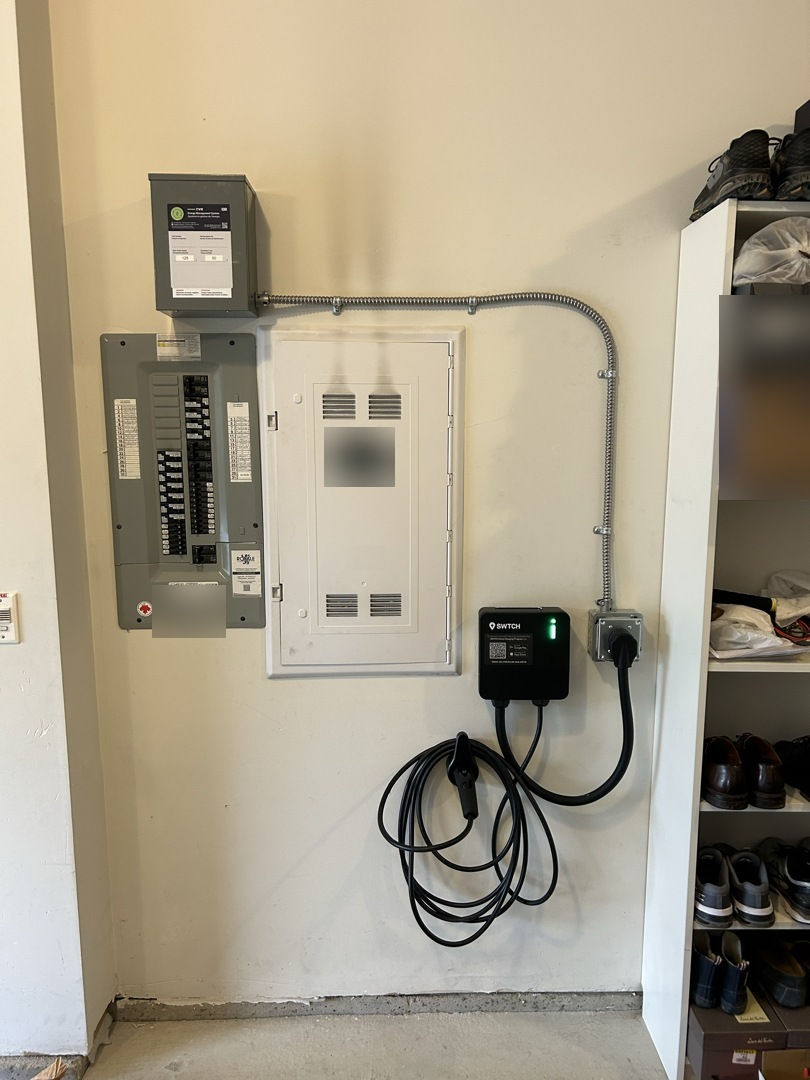
Here's how we decide, what each option involves, and how to make the most of the current rebate.
Start with a load calculation, not a guess
Whether your home can support an EV charger has nothing to do with how full your panel looks or what a neighbour was told. It depends on a load calculation under the Canadian Electrical Code: your home's square footage, heating, range, dryer, hot water, hot tub, heat pump and any other major loads, compared against the size of your service.
A Level 2 charger is a big, long-running load, typically on a 40A or 50A circuit. If the calculation shows your service can carry it, we install it directly. If it can't, you have two paths.
Option 1: Load management with a DCC device
A DCC device (often called an EV energy management system) monitors your home's total electrical use in real time. When the house approaches the limit of your service, for example when the oven, dryer and heat are all running, the DCC briefly pauses the charger. Once demand drops, charging resumes automatically.
In practice, most EV charging happens overnight when household demand is low, so most owners never notice the pauses.

Load management usually makes sense when:
Your service is 100A or 125A and the load calculation comes up short only for the EV.
You charge mostly overnight and drive typical daily distances.
You want to avoid the cost, utility coordination and wait times of a service upgrade.
Your panel is in good condition and has room for the new circuit.
At It's On Electric, a DCC device is $2,125 + GST when the calculation shows it's needed, on top of the charger install.
Option 2: A service upgrade to 200A
A service upgrade replaces or upsizes your main service and usually your panel, and it has to be coordinated with BC Hydro. Service upgrades are a bigger investment, starting at $6,000 + GST, and utility fees and scheduling apply. The timeline depends partly on the utility, not just on us.
A service upgrade usually makes sense when:
You're planning other big electrical loads soon: a heat pump, hot tub, induction range, a second EV, a suite, or a renovation.
Your existing panel is old, damaged, full, or a type that should be replaced anyway.
You need fast charging during the day regardless of what else the house is doing.
The load calculation shows you're near capacity even before the EV.
If two or more of those apply, upgrading once is often smarter than adding load management now and upgrading later. We'll lay out both options honestly so you can decide.
Our flat-rate Level 2 install pricing
We quote in writing before any work starts. All prices are + GST and based on a customer-supplied charger located within 10 ft of the panel:
Hard-wired charger: $1,500
Receptacle (plug-in) install: $1,700
Beyond 10 ft: $15 per additional foot
DCC load management, when required: $2,125
Deposit: $600, applied in full to your install
200A service upgrade, if needed: starting at $6,000
There are no surprises on the day: if your home needs load management or other work, you'll know before we book.

The BC Hydro home charger rebate
The provincial EV charger rebate for single-family homes is still open. Under BC Hydro's EV Charger Rebate Program Guide (updated July 15, 2026), it covers 50% of eligible costs, up to a maximum of $350, whichever is lower. Indigenous applicants can get 75% of eligible costs, up to $750. The program is funded by CleanBC and administered by BC Hydro, with ongoing intake.
A few practical notes:
Eligibility rules, including approved charger models, apply. Check that your charger qualifies before you buy it.
Keep your itemized invoice and permit documentation; you'll need them to apply.
Rebate amounts and terms can change without notice, so confirm current details on the BC Hydro website before you apply.
Sources: BC Hydro EV Charger Rebate Program Guide (July 15, 2026), bchydro.com; Go Electric BC, Residential Charging, goelectricbc.gov.bc.ca/find-rebates/residential-charging/.

Permits: not optional
Every Level 2 EV charger install needs an electrical permit, and so does any load management device or service upgrade. Permitted work is inspected, protects your home insurance, and gives you documentation for the rebate and for resale.
We pull the permit, complete the work to code, close the permit, and give you a copy along with your itemized invoice and photos of the installation.
The bottom line
A 200A upgrade is the right answer for some homes, but it isn't automatic. For many South Surrey and White Rock homeowners, a proper load calculation shows that a DCC device gets you reliable overnight charging for far less disruption. For others, especially those planning a heat pump or other major upgrades, doing the service once and doing it right is the better long-term investment.
Either way, the decision should come from your home's actual numbers.
Ready to charge at home? Send us a photo of your panel and where you'd like the charger, and we'll tell you whether you need load management, a service upgrade or neither. Book your EV charger assessment with It's On Electric today.
— The It's On Electric team
Serving Surrey, South Surrey, White Rock, Cloverdale and Langley


Comments